
AI strategy, media innovation, and practical growth systems.
I help brands and creators use AI, digital media, SEO, and automation to produce better content and grow with clarity.
Omar Alshal
-
03/08/2026
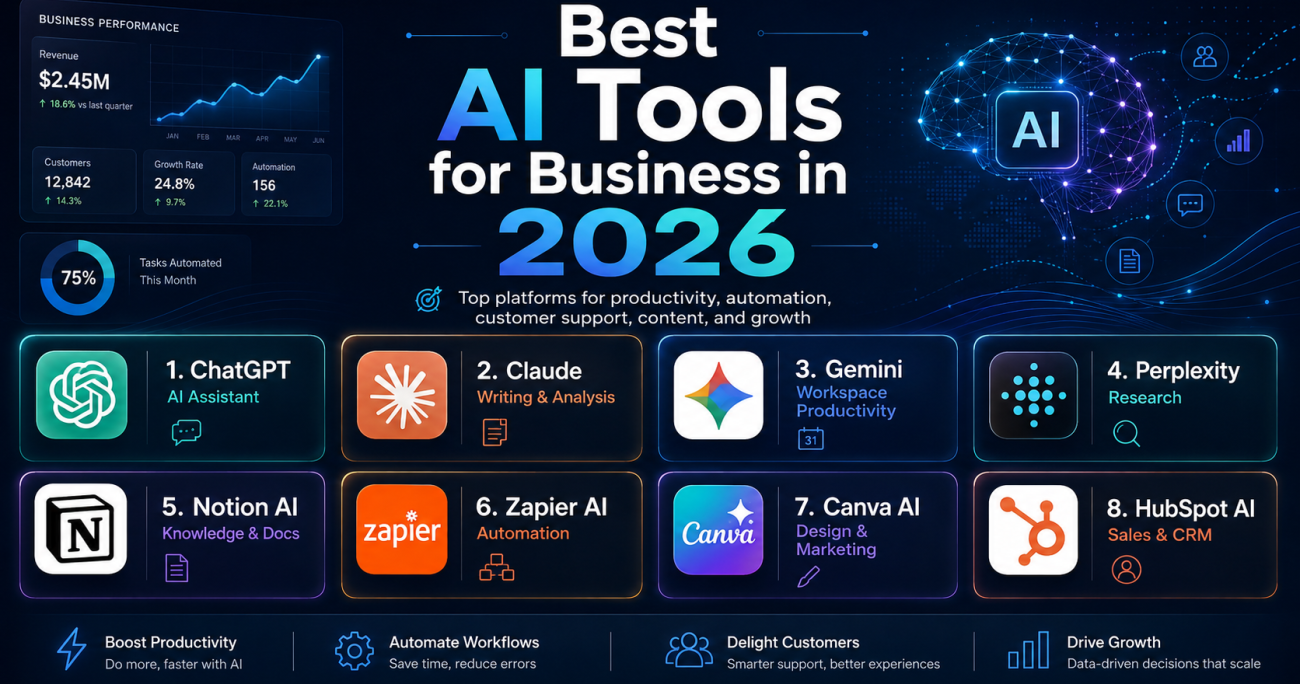
The Best AI Tools for Business in 2026
The business world in 2026 looks nothing like it did five years ago. Artificial intelligence has moved from a competitive edge to a baseline expectation. Companies that once wondered whether to adopt AI are now asking which tools to adopt next.
After years of consulting with businesses across the Middle East and beyond, I have seen firsthand which tools deliver real results and which are impressive in demos but disappointing in daily use. This is not a list of every AI tool available. It is a curated guide to the tools that are actually changing how businesses operate right now.
Why 2026 Is Different
The AI tools of 2022 and 2023 were largely about generating text. You typed a prompt, you got output. Useful, but limited.
The tools of 2026 are different in a fundamental way: they act. They do not just produce content — they execute tasks, manage workflows, connect systems, and make decisions on your behalf. The shift from AI as a writing assistant to AI as an operating layer is the most important development in business technology this decade.
With that context in mind, here are the categories and tools that matter most.
1. AI Business Assistants and Automation Platforms
The problem they solve: Your team spends an enormous amount of time on repetitive coordination work — scheduling, summarizing, drafting, routing information. This is time that could be spent on decisions only humans can make.
Top picks:
Sintra AI has emerged as one of the most practical platforms for small and mid-sized businesses. Rather than giving you a single AI assistant, it gives you a team of specialized helpers — one for content, one for sales outreach, one for customer support, one for SEO, and so on. Each operates within its domain and can execute tasks autonomously on a schedule. For business owners who wear many hats, this kind of delegation to AI is genuinely transformative.
ChatGPT (Enterprise) remains the most versatile general-purpose assistant available. The enterprise tier offers stronger privacy controls, expanded context windows, and integrations with business tools. It is the right choice for teams that need a flexible thinking partner across a wide range of tasks.
Microsoft Copilot 365 deserves mention for organizations already embedded in the Microsoft ecosystem. Its integration with Word, Excel, Outlook, and Teams means you do not need to change workflows — AI simply enhances the tools you already use.
What to look for when evaluating this category: Integration with your existing tools, the ability to act autonomously (not just respond), and clear data privacy practices.
2. AI Video Creation and Editing
The problem they solve: Video is the most effective content format on almost every platform, but producing it is expensive and time-consuming. AI video tools have collapsed the cost and time required dramatically.
Top picks:
HeyGen continues to lead for AI avatar-based video. You can create a digital version of yourself, input a script, and produce a professional video in minutes. For businesses creating training content, product explanations, or personalized outreach at scale, HeyGen offers a level of output that was previously only possible with a full production team.
Kling (Kuaishou) has become a standout choice for generating cinematic, high-quality video from text or image prompts. The quality of movement and scene rendering in Kling makes it suitable for marketing content that needs to look premium.
Seedance 2 is worth watching closely. Its ability to generate coherent, story-driven video sequences makes it particularly useful for social media campaigns and product showcases where narrative matters.
CapCut (AI features) bridges the gap between AI generation and practical editing. Its AI tools for auto-captioning, background removal, and template-based production make it one of the most efficient editing tools available, particularly for short-form video.
What to look for: Output resolution and quality, how much control you have over the final look, and whether the tool fits into your existing production workflow.
3. AI Image and Design Tools
The problem they solve: Professional-quality visual content used to require either a skilled designer or a significant budget. AI design tools have made it possible to produce brand-consistent visual assets quickly and affordably.
Top picks:
Midjourney produces some of the most aesthetically refined AI-generated images available. For brands where visual quality is a central part of the identity, Midjourney consistently delivers at a level that impresses.
Adobe Firefly is the responsible choice for commercial use. Because it is trained on licensed content, you can use outputs without the intellectual property concerns that surround some other tools. For businesses producing content at scale, this matters.
Canva (AI features) has become the most practical design platform for non-designers. Its Magic Design, text-to-image, and background generation tools sit inside a familiar interface that most team members can use without training.
Nano Banana Pro deserves recognition here for its strong performance in Arabic-language design work. For businesses serving Middle Eastern audiences, finding tools that handle Arabic typography and right-to-left layouts well is a real need, and this tool addresses it.
What to look for: Commercial usage rights, consistency with your brand guidelines, and ease of use for non-designers on your team.
4. AI for Content and Copywriting
The problem they solve: Maintaining a consistent presence across multiple platforms requires a volume of content that most teams cannot produce manually. AI writing tools handle the volume while you handle the strategy and final voice.
Top picks:
Claude (Anthropic) has established itself as the strongest AI for complex writing tasks that require nuance, careful reasoning, and a natural tone. For long-form content, analysis, and anything where the quality of thinking matters as much as the quality of phrasing, Claude consistently performs at a high level.
ChatGPT remains excellent for versatility. From social media captions to email sequences to product descriptions, it adapts quickly to different formats and tones.
Jasper is built specifically for marketing teams that need to produce consistent, brand-aligned content at scale. Its campaign management features and brand voice settings make it more useful than general-purpose tools for organizations with well-defined content operations.
What to look for: The ability to train the tool on your brand voice, multi-language support, and integration with your content management systems.
5. AI for Sales and Customer Engagement
The problem they solve: Following up consistently with leads, personalizing outreach, and responding quickly to customer inquiries are all tasks that AI can now handle at a level that was previously impossible without a large team.
Top picks:
Instantly AI has become the standard for AI-powered cold email at scale. Its ability to personalize outreach using data points while managing deliverability makes it a genuine revenue driver for teams doing outbound sales.
Intercom (Fin AI) is the most mature AI solution for customer support. Its ability to resolve a significant percentage of customer inquiries without human intervention, while escalating complex issues appropriately, has made it the go-to for businesses that take customer experience seriously.
HubSpot (AI features) has woven AI throughout its CRM in ways that are genuinely useful — predictive lead scoring, automated follow-up sequences, and AI-assisted deal coaching. For teams already on HubSpot, the AI capabilities are worth exploring fully.
What to look for: Personalization quality, integration with your CRM, and how gracefully the tool hands off to a human when the situation requires it.
6. AI for Analytics and Business Intelligence
The problem they solve: Data without interpretation is noise. Most businesses collect more data than their teams can meaningfully analyze. AI analytics tools turn raw data into decisions.
Top picks:
Tableau (Einstein AI) allows users to ask questions in plain language and receive visual, interpretable answers from their data. For business leaders who are not data analysts by training, this kind of interface is genuinely useful.
Google Looker has integrated AI capabilities that surface anomalies, identify trends, and generate natural language summaries of complex datasets. Combined with Google’s broad data ecosystem, it is a strong choice for businesses already using Google Workspace.
Perplexity AI deserves mention in this category as a research and intelligence tool. For teams that need to monitor markets, competitors, and industry trends, its ability to synthesize current information with cited sources is significantly faster than traditional research methods.
What to look for: Connectivity to your existing data sources, the ability for non-technical users to extract insights, and the quality of the AI’s explanations, not just its conclusions.
7. AI for SEO and Digital Marketing
The problem they solve: Search visibility is increasingly competitive and increasingly complex. AI tools that can analyze keyword opportunities, audit technical issues, and assist with content optimization are no longer optional for businesses that depend on organic traffic.
Top picks:
Semrush (AI Writing Assistant) combines one of the most comprehensive SEO data platforms available with AI content tools that are natively informed by keyword and competitive data. The combination means you are writing content with SEO strategy built in from the start.
Surfer SEO has become the standard for content optimization. Its ability to analyze top-ranking pages and provide real-time guidance on structure, keyword density, and coverage helps produce content that performs.
Ahrefs remains the gold standard for backlink analysis and keyword research. Its recent AI features for content gap analysis and opportunity identification have made it even more useful for teams developing content strategies.
What to look for: Integration with your content workflow, the quality of the underlying data, and how actionable the recommendations are.
How to Choose: A Simple Framework
With hundreds of AI tools available, the question is not which tools are best in the abstract. The question is which tools are best for your specific business, team, and stage of growth.
Before adopting any new AI tool, ask yourself four questions:
The Honest Assessment
AI tools in 2026 are genuinely powerful. The gap between what a well-equipped solo operator or small team can accomplish today versus five years ago is remarkable. But the tools are not magic. They amplify what you bring to them. A clear strategy gets clearer. A confused strategy gets produced faster and more expensively.
The businesses seeing the best results from AI are not the ones with the most tools. They are the ones that have identified their highest-leverage processes, chosen the right tools for those specific processes, and built the discipline to use them consistently.
Start there, and the tools will follow.
Need a practical AI roadmap for your company? Work with an AI consultant for Middle East businesses to select the right tools, workflows, and implementation priorities.
2 thoughts on “The Best AI Tools for Business in 2026”