Feature overload
Long feature lists create cognitive load. A relevant workflow makes value visible in seconds.
An AI product launch in the Middle East is not a translation project. It is a trust, education, and relevance challenge. This guide shows global AI teams how creator-led product education can turn unfamiliar technology into a workflow Arabic-speaking audiences understand and adopt.
 Global AI innovation → practical Arabic product education
AI companies often enter a new region with a polished English demo, a list of features, and a global launch video. The product may be excellent, yet the campaign underperforms because the audience cannot immediately connect those capabilities to a familiar need.
Long feature lists create cognitive load. A relevant workflow makes value visible in seconds.
Words may be correct while the examples, tone, and calls to action remain culturally distant.
New tools need credible demonstration, not an enthusiastic claim with no evidence of real use.
A complex AI workflow may need a tutorial for evaluation and short-form content for discovery.
Without early local testing, confusing terms and unsuitable use cases reach the public launch.
Awareness disappears when a campaign does not support evaluation, adoption, and repeated use.
Arabic localization starts with language, but it cannot end there. A useful localized campaign selects examples the audience recognizes, demonstrates an outcome they care about, and explains the product in a voice that feels natural rather than imported.
For a video-generation platform, the strongest regional example might be an Arabic marketing video, a digital presenter, or a social campaign. For an AI productivity product, it may be research, content planning, customer communication, or a small-business workflow. The creator’s job is to find the bridge between product capability and regional usefulness.
A creator needs enough time to use the product, test the main workflow, identify friction, and understand where the tool is genuinely different. Credible content begins with experience. A brief can guide the message, but it should not replace product understanding.
The first piece of content should not explain everything. It should solve one recognizable problem for one defined audience. That creates a clear narrative: the problem, the workflow, the result, and the reason the product is worth trying.
Screen recordings, before-and-after examples, workflow decisions, and honest limitations build more trust than abstract claims. For AI products, the demonstration is often the proof.
Short content can create curiosity. Long-form content helps people evaluate a complex tool. Tutorials support adoption. Follow-up content can introduce advanced workflows. A launch performs better when each format has a defined job.
Questions, comments, watch behavior, clicks, and trial feedback reveal what the market still does not understand. The next activation should answer those objections or expand the use case—not repeat the launch announcement.
The right campaign does not need every format. It needs a deliberate path from discovery to confident use. For some products, one strong dedicated video is the best starting point. For others, a launch package or longer partnership creates more value.
Follower count is useful context, but it does not prove that a creator can explain a new technology or help people adopt it. For an AI product launch in the Middle East, evaluate the creator’s ability to understand the product and translate complexity into a practical story.
A focused brief shortens production time and produces better content. Before outreach, prepare the information below. If something is still undecided, say so—the creator may help define the most useful option.
Strong partnerships also leave room for the creator’s editorial judgment. The company knows the product. The creator knows how the audience learns, evaluates, and responds.

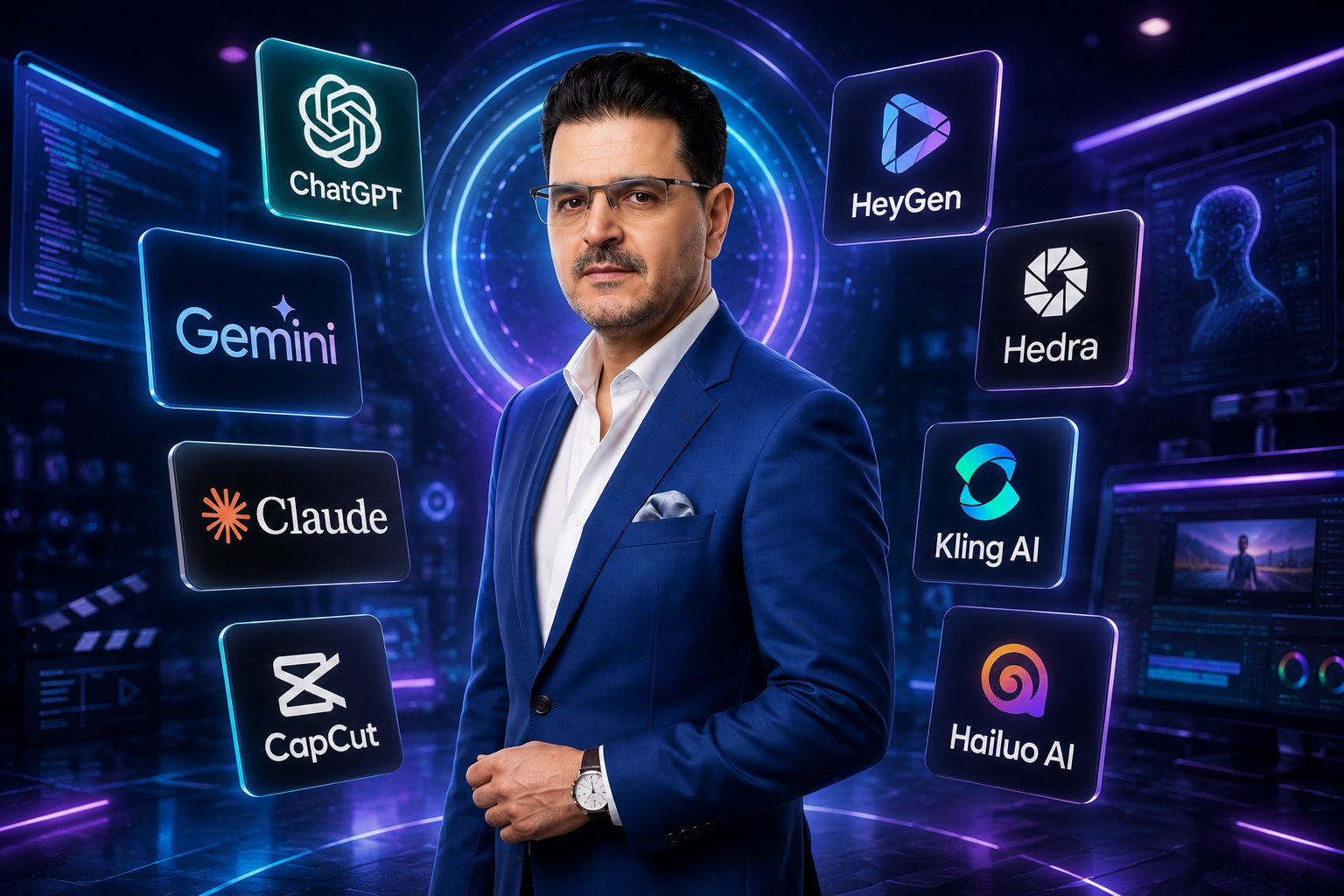
Omar combines Arabic communication, English-language industry access, practical AI knowledge, television experience, and a business perspective. His role is not simply to announce a tool. It is to understand it, choose the strongest regional story, and communicate that story with clarity and credibility.
Selected technology collaborations include HeyGen, Hedra, Sintra AI, OpenArt AI, PixVerse, Hailuo AI, Kling AI, CapCut, and other digital platforms.
Omar serves as an ambassador for HeyGen and Hedra. Additional selected collaborations span AI video, generative media, business automation, hosting, commerce, Arabic AI creation, and creative production.
 ShopifyCommerce platform
Share the product, target audience, launch date, priority market, desired deliverables, usage rights, and budget range. You will receive a focused response on fit and the most useful collaboration format.
For most consumer, creator, productivity, and business AI products, Arabic content materially improves understanding and trust. English can remain part of the campaign, but localized demonstrations help people see how the product fits their own work and context.
Translation changes language. Localization changes the example, framing, workflow, terminology, cultural context, and call to action so the product feels relevant to the intended market.
The strongest mix usually combines a detailed product demonstration for evaluation with short-form content for discovery. The exact format should depend on product complexity, launch stage, audience, and campaign objective.
A flat fee fits defined production deliverables. Affiliate compensation fits measurable conversion. Hybrid structures can align quality production with performance incentives. Long-term ambassador programs are useful when education and repeated use matter.
Ideally before the public launch brief is finalized. Early product access gives the creator time to test the workflow, identify local use cases, flag confusing positioning, and build a demonstration that feels credible.
Yes. Depending on fit and scope, a launch can include dedicated YouTube content, integrated segments, short-form social content, product education, media appearances, workshops, and longer-term ambassador activity.